
Atomic number facts for kids
An atomic number is the number of protons inside an atom. Protons sit right in the center, which scientists call the atomic nucleus. Every single chemical element has its own special atomic number. Scientists use the symbol Z for this value. The letter comes from Zahl, which means number in German. In an uncharged atom, this number also equals the total of electrons.
Together, protons and neutrons make up almost all of an atom's weight. The atomic number added to the neutron number creates the atomic mass number. Atoms with matching proton counts but different neutrons are isotopes. A monoisotopic element has only one naturally occurring stable type. Measuring these weights helps scientists find an element's official atomic weight. Even unusual creations like an exotic atom help researchers learn about matter.
Contents
What Does the Atomic Number Tell Us?

The atomic number gives an element its unique identity. For example, any atom with six protons is always carbon. In AZE notation, scientists write the numbers beside the chemical symbol. The mass number sits as a superscript on the upper left. The atomic number is written below it as a subscript.
An element's chemistry depends on its electrons. These tiny particles travel within an electron shell. The outer area, called the valence shell, controls chemical bonding. Principles of quantum mechanics explain how this works. Because of this, the atomic number determines how an element reacts.
How Scientists Discovered Atomic Numbers

Long ago, chemists did not know about protons. In 1869, Russian scientist Dmitri Mendeleev created the first modern periodic table. He put elements in order using their atomic weight. Yet, a few elements did not match their neighbors. Mendeleev swapped tellurium and iodine so their chemical traits lined up. He also noticed puzzles with argon and potassium, as well as cobalt and nickel. Similar traits among the lanthanide group caused extra confusion.
In 1911, Ernest Rutherford proposed the Rutherford model of the atom. Two years later, Antonius van den Broek suggested that nuclear charge matched an element's table position. Rutherford's lab partner developed the Bohr model, showing how electrons orbit the center.
Moseley's Big Breakthrough

In 1913, English physicist Henry Moseley tested these new ideas. He fired energy beams inside an x-ray tube. Moseley studied the glowing spectral line patterns from targets like aluminium up to gold. He saw the photon frequencies grew in a neat arithmetic progression.
This discovery became known as Moseley's law. It proved that each element has a whole number of positive charges. Moseley proved that the rare-earth group from lanthanum to lutetium holds exactly 15 elements. His work also revealed missing spots for undiscovered elements. Scientists soon discovered these missing pieces, completing the row to curium.
Protons and Neutrons
Earlier thinkers supported Prout's hypothesis, which guessed that heavier elements were made of hydrogen. In 1917, Rutherford used a nuclear reaction on nitrogen gas. He proved hydrogen nuclei were basic building blocks and named them protons.
At first, scientists thought extra electrons lived inside the nucleus to cancel charges. In 1932, James Chadwick completed the discovery of the neutron. This neutral particle solved the puzzle completely. Scientists finally knew that the atomic number is simply the count of protons.
Creating Superheavy Elements
Today, all 118 known elements have been observed. Scientists can create a new superheavy element in special labs. They smash lighter atoms together at high speeds. These giant atoms break apart quickly, measured by their short half-life. Some physicists believe an island of stability might exist far ahead. A purely theoretical particle mix called neutronium would have an atomic number of zero.
See also
 In Spanish: Número atómico para niños
- Chemical element
- Mass number
- Neutron number
- Prout's hypothesis
- Henry Moseley
Images for kids
-
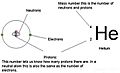
An explanation of the superscripts and subscripts seen in atomic number notation. Atomic number is the number of protons, and therefore also the total positive charge, in the atomic nucleus.
-
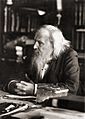
Russian chemist Dmitri Mendeleev, creator of the periodic table.
-
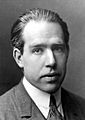
Niels Bohr, creator of the Bohr model.
-
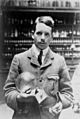
Henry Moseley in his lab.


